


If You Build It, They Will Come… But Can You Reuse It?
By andrew thomson, head of Design Engineering, charterhouse
Adapted from a talk delivered at the V&A for CLEAPSS Future Minds
12 november 2026
The exchange, charterhouse
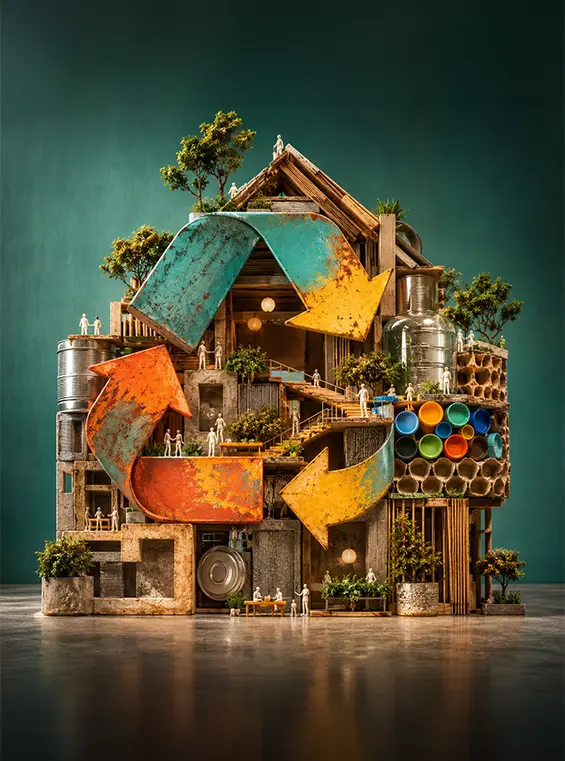
Nearly a decade ago, I borrowed that line from Field of Dreams to make the case for choosing the right qualifications and creating an inspiring Design and Technology curriculum, in a piece for OCR exam board.
My belief was simple: if we build the right foundations, with enthusiasm, creativity and a genuine connection to the world beyond the classroom, great things will follow.
I still believe that, but I now find myself asking a slightly different question.
If we build it, can we reuse it?
Sustainability has become central to how I approach Design Engineering. It is not a separate topic to be squeezed into an already busy curriculum, but a mindset that shapes how we approach projects, materials, manufacturing and problem-solving. The challenge is to make it part of the way students think about design, rather than simply something they learn about.
At Charterhouse, sustainability is embedded within our departmental aims, alongside interdisciplinary thinking, curiosity, going beyond and having fun. That fits naturally with the School’s “Try Everything” ethos. I don't believe every project needs to achieve everything, but across the year, students should meet a range of opportunities that develop all of these qualities.
Building a curriculum for the future
One of the great privileges of my time at Highgate School was teaching across such a wide age range, from Reception to Year 13. It allowed me to develop a curriculum in which sustainability could be revisited and deepened over many years.
At Charterhouse, where Design Engineering begins in Year 9, I am working towards the same effect, including by collaborating with feeder schools across Surrey so that students arrive with more common experience.
The ambition is a journey in which students steadily develop their understanding of materials, systems, sustainability and responsible design.
A simple question can be asked at almost any stage:
What happens to this outcome when we have finished with it?
It can change the way a student approaches a design brief entirely. It also invites a second thought: not every learning objective needs a physical outcome at all.
Every material has a route out / pathway
One principle I have tried to establish in our department is that every material that comes into the workshop should have a route out.
We separate waste carefully, reducing the amount that reaches our general waste bins. Plastic offcuts can be shredded, pressed into sheets or injection moulded into new products, which we then sell. Components can be disassembled and reused. Prototypes can be redesigned rather than discarded.
We are working towards a workshop where materials and components are reused as many times as possible, and nothing ends up in landfill or is burnt.
This is particularly exciting when sustainability meets entrepreneurship.
Students can manufacture products from recycled plastics, develop their own brands and sell their creations, with the income reinvested in new equipment, materials or moulds.
We have also worked with local schools, helping them recycle their own waste plastics into products that can be sold within their communities.
There is something powerful about a student realising that what was once considered waste can become a useful product, a business opportunity and a reason to learn more about manufacturing.
Designing for disassembly
A question I increasingly ask students is whether their finished product could be taken apart and reused.
Consider a GCSE project involving a table tennis ball launcher, with 3D-printed components and VEX robotics. Rather than treating the prototype as a single-use outcome, students can consider how the printed parts might be recycled back into filament and how the robotic components could be reassembled into another project.
This encourages students to think beyond the immediate brief.
How could the product be repaired? Could its components be separated? Which materials are difficult to recycle? Could the design be improved to make reuse easier?
These are not always straightforward questions, and there is rarely a perfect answer. But the process of asking them produces a more thoughtful designer.
We need to challenge the assumption that a successful product is simply one that works.
Perhaps we should also be asking how efficiently it uses resources and what happens at the end of its life. Exam boards and the Department for Education might one day go further, expecting every outcome to be recyclable, with its materials separable.
Sustainability can be part of almost any project
Some of the most successful projects are those that combine practical engineering with a meaningful context.
Students have designed robots to collect plastic from waterways, created solar-powered torches and built wind turbines. We have explored air quality using Dyson’s environmental monitoring equipment, with students collecting data and presenting their findings to the wider school as part of Clean Air Day in London.
At Highgate, students collected discarded Tim’s Dairy yoghurt pots from the dining room and turned them into combs. The project involved far more than manufacturing, not least because the catering staff kindly ran the pots through the school dishwashers. Cleaning is so often the real barrier to recycling plastic.
We also converted a bicycle into a phone-charging station, allowing students and staff to generate electricity through exercise.
These projects are enjoyable, but their real value lies in the questions they generate.
How much energy are we using? Where do our materials come from? Could we achieve the same outcome differently? What are the wider consequences of our decisions?
Sustainability provides a context for learning about electronics, programming, materials, mechanisms and manufacturing. It also gives students a reason to care about them.
Repair, reuse and a little ingenuity
One initiative I particularly enjoy is Fix It Club, which I started at Highgate and continue with at Charterhouse. Students and staff brought in broken objects to see whether they could be repaired.
There is something satisfying about discovering that a product which might otherwise have been thrown away can be brought back to life.
Repair requires curiosity, patience, experimentation and problem-solving. It also challenges the increasingly familiar idea that replacing something is easier than fixing it.
We have also explored upcycling through visits to recycling centres and aircraft scrap yards, including those run by companies such as Dappr, where students identify discarded components that might form the basis of a new product.
At Highgate, with help from my technician, we even repurposed old workshop stools into music trophies, which prompted a caption I remain rather proud of: “Woodn’t you like to win this amazing music award?” It is a simple example of how a little creativity can give an object a completely new purpose.
The same thinking has extended into our Greenpower Goblins projects, where students have used discarded materials to build the bodywork of their vehicles.
Learning that lasts beyond school
Perhaps the most rewarding aspect of embedding sustainability into a curriculum is seeing how these ideas develop over time.
One former student’s journey illustrates it well. Her GCSE project was a bicycle-powered charging system. She then developed an upcycling project using components from an old aeroplane.
At A-level, she created a system that scanned the barcode on a product wrapper and identified the appropriate waste stream.
She went on to study environmental engineering and completed a master's degree at Cambridge.
Her story shows how sustained exposure to design challenges can shape a student's interests, ambitions and future career.
It reinforces my belief that we should not underestimate the impact of the topics we introduce in the classroom.
We may see them as individual assignments, but for students they can become stepping stones towards something much bigger.
So, what does the future look like?
I would say we are around 70% of the way towards where I would like our sustainability approach to be at Charterhouse.
There is still plenty to do.
I would like to see more collaboration between schools, more opportunities for students to share ideas, and a curriculum in which sustainability becomes an increasingly natural part of the design process.
It is not always as simple as choosing a recycled material. There are real considerations around durability, energy use, manufacturing and the wider lifecycle of a product.
But every project offers a chance to ask better questions.
My departmental aims remain interdisciplinary thinking, curiosity, going beyond and having fun. I want students to leave the workshop with the confidence to try something new, the willingness to experiment and the ability to think critically about the impact of their decisions.
Returning to Field of Dreams, perhaps the challenge for us as educators is not simply to build an inspiring curriculum and hope that students will come.
It is to build one that gives them the skills, knowledge and confidence to improve the world they inherit. To be become creative problem solvers for todays and tomorrow world.
And if we can do that while turning a few yoghurt pots, plastic offcuts and discarded workshop stools into something useful along the way, then I think we are heading in the right direction.
After all, good design is about solving problems. Great design considers what happens next.
It was a pleasure and an honour to deliver this talk at the V&A, and I am grateful to CLEAPSS for hosting and organising. You can watch the talk and others from the series here.
You can also see more of our work on the departmental Instagram, @Charterhouse_DE
Andy Thomson is Head of Design Engineering at Charterhouse and one of the UK's most respected voices in Design and Technology education. With extensive experience across both the independent and state sectors, he has built a reputation for innovation, academic excellence, and pioneering work in emerging technologies.
Throughout his career, Andy has developed high-performing departments that place design, engineering, robotics, and technological innovation at the heart of the educational experience. His commitment to remaining an active classroom practitioner is reflected in the fact that he has taught pupils across every age range, from Year 3 through to Year 13, giving him a rare and comprehensive understanding of the entire student journey and enabling him to translate educational theory into outstanding classroom practice.
Beyond his own schools, Andy has made a significant contribution to the wider profession. A passionate advocate for outreach and knowledge-sharing, he has worked extensively with schools across the country, delivering training, mentoring teachers, and supporting pupils through initiatives including Teach First and Teach Design. His commitment to widening access to Design and Technology has even included learning British Sign Language in order to teach deaf pupils from local schools.
Andy is widely recognised for his leadership and innovation in the field. He was named VEX Robotics Teacher of the Year (2014) after successfully embedding robotics into the curriculum, with three of his student teams progressing to the VEX World Championships in Kentucky, USA. He subsequently received the James Dyson Foundation Teacher of the Year Award (2016) and the Design and Technology Association's Subject Leader of the Year Award (2016), recognising his outstanding contribution to Design Engineering education.
Today, as Head of Design Engineering at Charterhouse, Andy continues to inspire the next generation of designers, engineers, and innovators, combining technical expertise, educational leadership, and an unwavering belief in the transformative power of creativity and engineering.


